Southern Bluefin Tuna
SBT, Bluefin Tuna, Tuna
Thunnus maccoyii
Overview
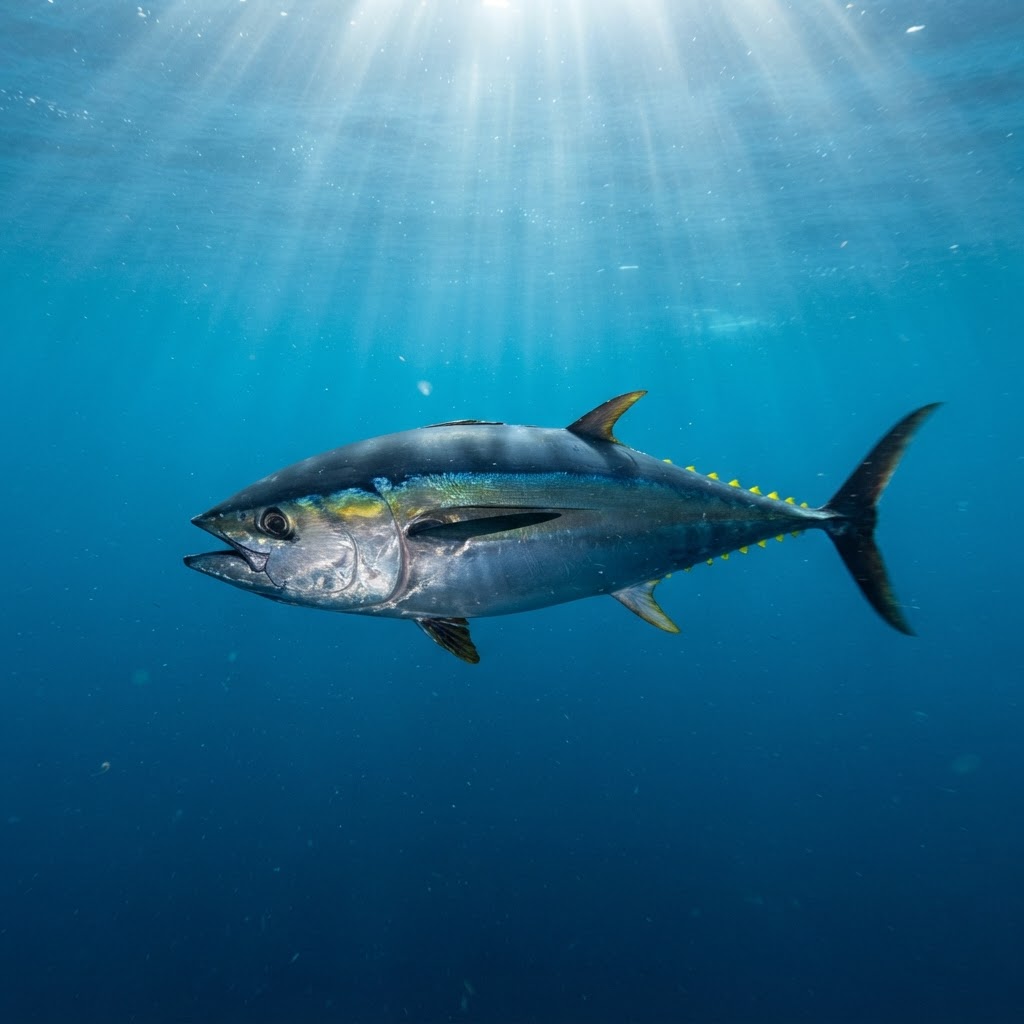
Southern Bluefin Tuna are South Australia's ultimate offshore prize. They gather in the Great Australian Bight and around the Eyre Peninsula through the warmer months, charging through baitfish schools and running metres on the strike. It is almost exclusively a boat fishery and a genuine bucket-list species for keen anglers.
Quick Info
Identification
A large, powerful tuna with a round, torpedo-shaped body, dark metallic blue-black back, silvery flanks and belly, and a row of yellow finlets running along the tail.
Deep, rounded body shape, small second dorsal and anal fins, yellow finlets, and a large caudal keel. Bigger fish look almost unmistakably like a mini torpedo.
Albacore have very long pectoral fins and clear white trailing fin edges; Skipjack Tuna have stripes along the belly and a different body shape. Yellowfin are rare in SA waters — the lack of a large yellow second dorsal fin rules them out.
Where to Find Them
Typical depth: 5-100 m
Fishing environments: Boat
When to Fish
How to Catch Them
Casting stickbaits or metals into working tuna, slow-trolling small skirted lures, or drifting with a berley trail of cubed bait. Once hooked, expect long runs — keep the rod bent and work the drag smoothly.
Skirted lures trolled at walking pace, small metals cast into bust-ups, or cubed baits drifted down a berley trail; fresh strips of bait floated back slowly get finicky fish.
Fast and erratic for cast metals into bust-ups — make the lure skip across the surface; slow the pace right down for skirted lures.
A sudden violent smash and immediate screaming run — tuna hook-ups are unmistakable and the first run is unforgettable.
Keep winding through the strike with the drag set, then lift the rod firmly; tuna hook themselves into a moving lure.
Book onto a charter from Port Lincoln for your first tuna — the gear, berley and boat positioning are everything. If fishing your own boat, start by looking for birds and white water on a calm morning.
Gear too light and drags too tight, running the boat through the bust-up and spooking the fish, and losing tuna by being slow to follow the run with the boat.
Best Baits
Rigs & Gear
The boat setup for Southern Bluefin Tuna — skirted lures or deep-diving hardbodies trolled in a spread behind the boat at walking pace, worked through baitfish schools and temperature lines.
A strong, simple rig built around a live baitfish swimming naturally — the setup for kingfish, tuna, mulloway and big snook when only the real thing will do.
Current SA Fishing Rules
CURRENT SA FISHING RULES
Always check current regulations before fishing. Fishing rules and closures can change.
Keeping Your Catch
Support the body with both hands and wet the tail pad — big tuna are heavy; never lift one by the tail alone. Handle carefully and release unwanted fish quickly by swimming them.
If keeping a tuna, dispatch it quickly and bleed behind the gills immediately — tuna bloodline spoils the flesh fast if left whole.
Slush ice as fast as possible. Tuna need to be iced hard; even an hour on a warm deck hurts the eating quality.
Cleaning & Filleting
Bleed, then remove the head, gills and bloodline. Larger fish are often gutted and left round for chunking into steaks.
Tuna fillet in large blocks down the backbone; remove the dark bloodline meat in the centre, which is strong-flavoured.
Skin is tough and usually removed; the flesh is eaten as bright red blocks or steaks.
Essentially boneless — tuna are prime filleting fish with no pin bones to chase.
Cooking
Beautiful when seared rare on a hot pan or BBQ, glazed over coals, or turned into a tuna poke. Do not overcook — tuna turns dry and chalky quickly.
Where to Catch Them in SA

A4GW CREW
Get the good stuff from A4GW straight to your inbox.
No spam. Unsubscribe anytime.