
Blue Swimmer Crab
Blue Manner Crab, Sand Crab
Portunus armatus
Overview
Blue Swimmer Crabs are a family favourite across South Australia's sheltered bays and jetties, taken with drop nets and dip nets. They are a true summer tradition — bait a few nets, pull them slowly, and cook a feed of sweet crab meat the same day. Easy, safe and genuinely fun for all ages.
Quick Info
Identification
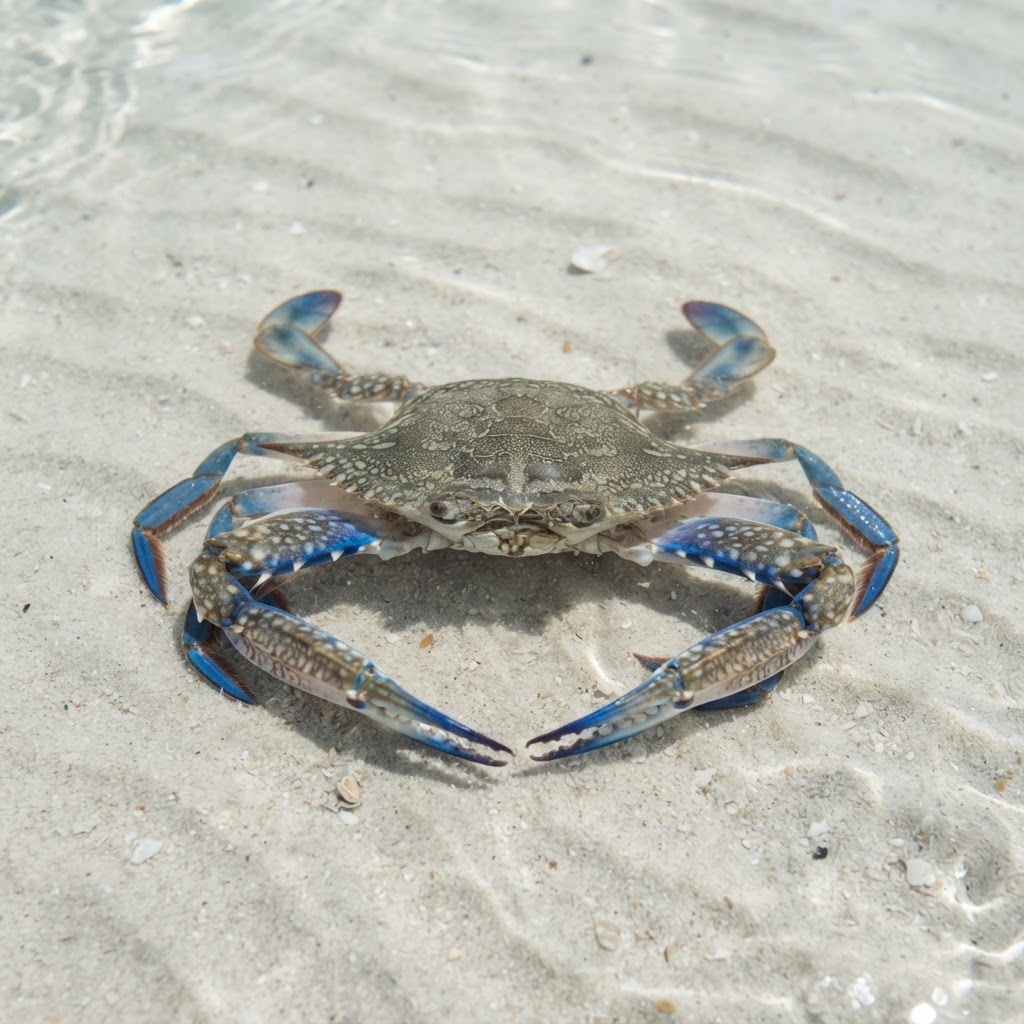
A striking crab with paddle-shaped rear legs (its 'swimmers'), long front claws and a carapace that changes from sandy mottled green-blue to vivid blue and orange as the crab matures.
Distinctive paddle-like rear swimming legs, a broad flattened carapace with nine points along each side, and claws raised in the classic defensive display.
In SA the Blue Swimmer Crab is the only common sand crab; juveniles can resemble other small swimming crabs — check the paddle legs and pointed carapace shape.
Where to Find Them
Typical depth: 0.5–10 m
Fishing environments: Jetty, Boat, Shore
When to Fish
How to Catch Them
Drop nets baited with fish frames or offal lowered from jetties and boats, or dip nets worked through shallow water. Rakes are used in permitted areas. Check the net and local crabbing rules for gear specifications and permitted areas.
Bait your drop nets with fresh, oily fish frames — crabs climb on from metres away. Keep the nets still on the bottom and lift smoothly and slowly.
With a hand line, a light tug as the crab scatters the bait; with nets, success is simply a slow, patient lift at the right moment.
Not applicable for netting — success is patience and a smooth lift. On a hand line, lift slowly and steadily when the tug comes.
Use fresh oily bait, fish several nets a few metres apart, and lift slowly and steadily — jerking the net scatters the crabs. Fish shallow warm water on summer afternoons.
Pulling nets too fast, bait that is not fresh, crabbing in winter when crabs have buried in the sand, and keeping crabs that do not meet the current size rules.
Best Baits
Current SA Fishing Rules
CURRENT SA FISHING RULES
Method: Carapace width
Measured at: Measured across the carapace (shell) from the base of the largest spines. All crabs must be measured as soon as they are caught and any undersize crabs immediately returned to the water.
Always check current regulations before fishing. Fishing rules and closures can change.
Keeping Your Catch
Pick up from behind, pinning the claws — they can nip hard. A net avoids the pinch entirely.
Not applicable — crabs are dispatched immediately before cooking, most commonly placed on ice to go to sleep.
An ice slurry puts crabs to sleep humanely and keeps them firm until cooking the same day.
Cleaning & Filleting
Cook whole first, then pick the meat from the claws, legs and body. Alternatively humanely kill, remove the back shell, gut and gills before cooking.
Crabs are not filleted — the sweet meat comes from the claws, legs and body; a crab cracker and patience are the tools.
The shell is discarded after cooking — the meat underneath is white, sweet and delicate.
No bones — the spongy gills ('dead men's fingers') and gut are removed before or after cooking.
Cooking
Steam or boil until bright orange, then crack and serve with seafood sauce. Crab meat is also superb in pasta, risotto and crab cakes.
Where to Catch Them in SA

A4GW CREW
Get the good stuff from A4GW straight to your inbox.
No spam. Unsubscribe anytime.